
Three Things Malcolm Taught Me

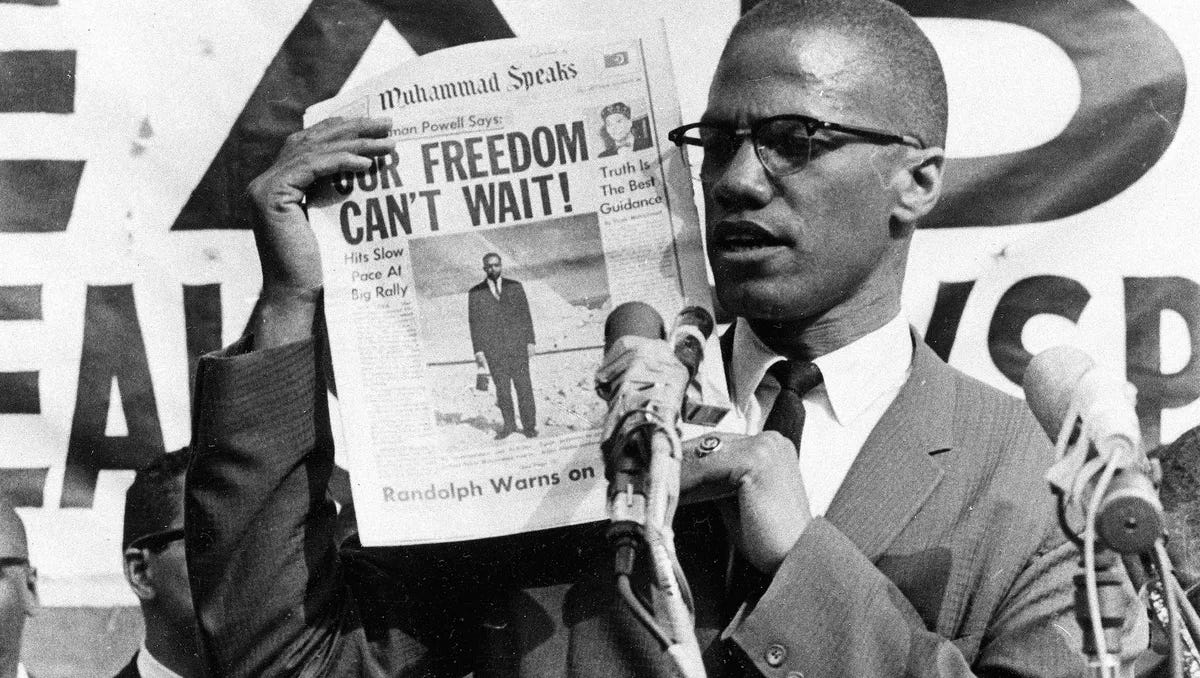
Comrades who have followed me for a while know that I am an unashamed and proud student of El-Hajj Malik El-Shabazz, known to posterity as Malcolm X. I would dare say that my entire generation that came to revolutionary politics in the wake of Michael Brown and Treyvon Martin are Malcolm’s children, much like the Black Panther Party. If I were to name one piece of media that radicalized me, it would undoubtedly be the opening speech to Spike Lee’s Malcolm X (1992). What pulls me, and others, to Malcolm X? What did he teach me? What can he teach you?
One: Waiting for others to deliver you freedom is a fool’s errand. This should be common sense, but many have been under the thumb of social democratic slavery for so long that they think an AOC will bring them freedom. Colonized people (Black Americans, Puerto Ricans, Hawaiians and other Indigenous people) have been oppressed, enslaved, and suffered theft of their lands by this empire. It has produced massive fortunes for a few, and for most settlers, it has secured them a mudsill (Du Bois’ words), a standard of living over and above ours. Malcolm taught that begging this system and these people for relief is a fool’s errand, and brings us no respect, but rather, scorn. When you beg the oppressor for reparations or any other relief with no force to back it up, you are simply ridiculous. Why would one who has power yield to one who has none? It is in this tradition that Huey P. Newton wrote his Functional Definition of Politics. In it, he lays out the reasons for our demands being ignored for decades - we have no power, or the ability to make phenomena act in a desired manner. To make our enemies act in a desired manner requires the ability to deploy force of various types. Without this, our demands are not real demands at all, but suggestions that can be safely ignored.
Two: Pan-Africanism is the only correct way forward for Black people. Being divided into squabbling tribes is a recipe for disaster, slavery, and destruction. Europeans were able to play havoc with us and disrupt our development process because they met us divided, and divided us further. Malcolm was raised in a UNIA household, and schooled early on in the teachings of Marcus Garvey, who developed, objectively, the largest organization of Black people in history. Pan-Africanism is, essentially, the idea and practice of unity of all people of African descent, both on the continent and in diaspora. The political and economic unity of the African continent on a socialist basis will generate a superpower, a force that will ensure that Black people are no longer disrespected and mocked as a people with no force or power. Only a fool (or an FBA) would forego the opportunity to unite Africans at home and abroad. Malcolm worked for this goal throughout the entirety of his political life. Cleaving to America’s rotten, bloated corpse is not the answer either. We are not Americans in anything but name, we are captured colonial subjects of this monstrosity called America, just like our Indigenous comrades in struggle. Our liberation is its destruction — we are in antagonistic contradiction. There can be no peace or reform that satisfies us.
Three: Liberation by any means necessary. Settler “leftists” condemn the Palestinian resistance, just as they condemned the Black Panther Party in its day, and Malcolm himself. They would instead have us rely on ineffective methods that are controlled by the enemy, such as elections, petitioning representatives who don’t give a shit about us, and the like. Were we freed by asking nicely, or through war? How did these settlers get hold of these lands? Through petitions, or through taking it? History has shown and Marxism teaches that class struggle, the struggle between colonizer and colonized, is always violent to various degrees. People are jealous of power, and do not give it up for the asking. Anybody who tells you that you can obtain power peacefully is either not serious, brainwashed by the ruling class, or your enemy. Either way, you should not listen to them.
On the 61st anniversary of his martyrdom, let these lessons guide you in your organizing and his struggle. Malcolm lives in you and me, in Palestine, in Minneapolis, and wherever people struggle for freedom.